Thursday, July 10, 2014

Arcade Project 02: Inspirations

A trip to Google Image Search will nab you some great pictures of people's home arcades.  I said earlier that I have seen some "bad" arcades in homes that look like garbage and cost a ton of money.  I am not going to show you examples because these people still worked hard, and I do not know the whole story.  What if the arcade room they have built is exactly like the arcade they had, so all the warts and flaws are there on purpose?  It could happen, people spend $5000 on Fender guitars that are made to look 50 years old after all.

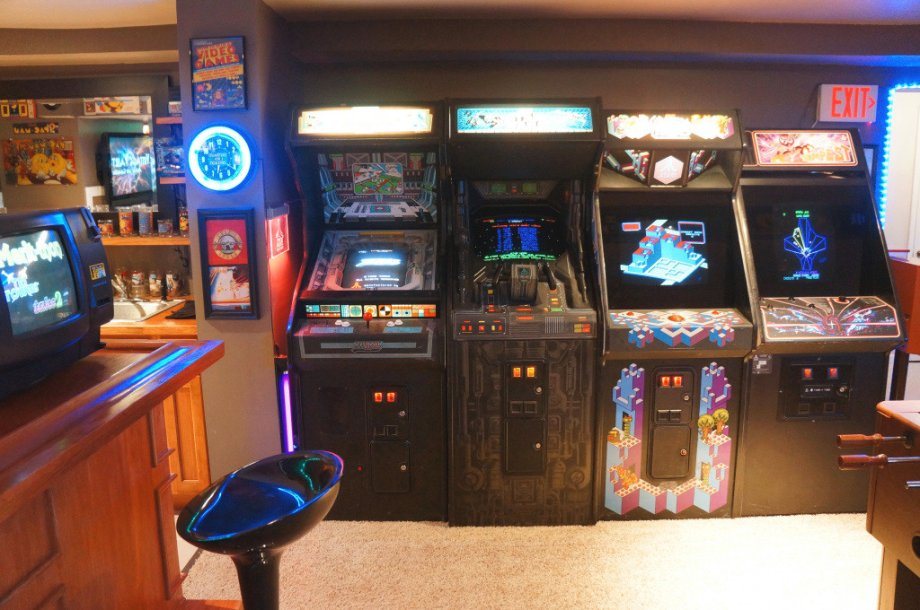
That picture above is what is right about home arcades.  It is way more money than I'd ever spend, but the guy knows what the hell he's doing.  It is not just about having some machines in a room, it is about getting the feel.  Look, because of technology I can play anything made before 2002 for very little money.  If I want to sit in front of a computer screen and use a connected PS3 controller, I can do that.  It is not about playing the games, its about creating an experience.

This one is more like I see my actual one being one day.  Just one feature of a basement entertainment room, near the food area.  I know this is actually just a small part of a larger arcade with stuff I do not want.  I never wanted a pool table, I never wanted a hoops game or a foosball table.  I am a video gamer.  I never wanted to play the pinball games when I was young, and I only grew an appreciation for skeeball in my late 20's.  All that's lucky for me because that shiz takes up a lot of space and a lot of money.

So what do I want?

This man's home arcade is probably the most expensive to fit in a one bedroom area.  Even so, he is sort of my inspiration for this.  I do not live in New York, and I do not want his rare and unobtainable arcades.  He has one of 10 Disney produced Wreck-it-Ralph arcades, and he has the literal machine used in the King of Kong documentary.  I have no use for that stuff.  I think I can do a room like that for way less money.  He was my inspiration for pricing out a "normal" sized room arcade.  He is also my inspiration in another way; his collection of quarter vending machines.

This is perfect, this is the kind of thing from people that "get" it think of that no one else does.  In his interviews he talks about how he bought them just for an atmospheric piece of decor, but how it has become his most favorite addition to the arcade.  He says that no matter who comes in, be it 60 year old journalists to the 20'something bloggers, before they get to the video games they see these vending machines and start telling stories.  He claims he never asks, people just light up and give him a story about using these machines as a kid.  Reading this instantly brought back memories of football helmets at Ingles.  It brought back sour gumballs, dinky plastic banannas, handfuls of Runts, and even brazil nuts.

My vending machine story.  There used to be a really cheap super market where there is a school now.  They used to rent that parking lot out for fairs every now and again, and I still have dreams of those fairs.  Anyway, fairs aside, they had vending machines in the front like everyone else, but they had one that no one ever had.  It was a vending machine full of oily, greasy, salty Brazil nuts.  Growing up the only way to get a Brazil nut was to wait to get some at Christmas, and you had to break the shells yourself, you know how hard that is as a kid to break those?  You use a hammer, and you end up getting a handful of crumbs.  Anyways, for a quarter you got a handful of perfect Brazil nuts, so in a way it was like getting a little Christmas every time I went to the store with my aunt.

Do you see?  I bet you thought of stories with those machines too.  So even though this guy inspired me to do "better" than him for way less money, and I've probably even talked a little trash about him... He had a great idea that made me change my mind about him, and now I want that for my own arcade one day.

Arcade Project 01: Plans and Why

"They came for the record store, and I stood by silent.  Then they came for the video rental chain, and still I said nothing.  When they came for the arcade, and there was no one left to defend me" -Arcade owner


I am fully aware that there is this weird nostalgia thing where we think that people of the future need to experience things we experienced in order for them to be "correct" after us.  The above paraphrased joke quote is a good example of the stuff I hear all the time.  All through the 2000's as the Tower Records and the small time record stores were dying as digital took over, we heard from their fans that the world is losing something special.  I really did not care about that because the march of technology is a good thing, as I say, and besides, there were never any good local record shops near me.  It was always chain stores shoveling the latest pop music out.  Lately, because Blockbuster going out of business, I hear a lot of nostalgia for rental stores.  I have great memories of rental stores, and it was fun looking through the cover art for movies and games and trying to judge like that for a gamble.  It really did allow me to experience more games for less money, but I had stopped using them long ago.  I never developed a relationship with any store workers, I mainly used chains and super markets because the mom and pop stores specialized in... garbage.


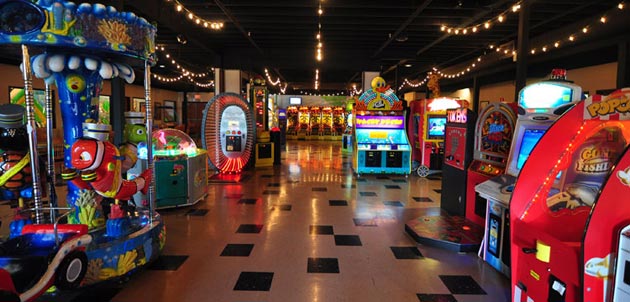
To tell you the truth, I do not even have a lot of arcade memories, and I think that's why I want one.  My arcade memories are regulated to the skate rink, the local movie house, and Six Flags.  I never frequented one very often, and by the time I was old enough to have a job and go to the mall every pay day, the arcades were filled with crap sports games and the latest gun simulator.  Gone were my great fighting games, gone were the Neo Geo shooters, and the "classic" section was filled only with the crap that the arcade could not get a good price on with Ebay.  It was much more financially viable to flip a Pacman arcade for $900 to some sucker than wait for that $1 of change at the end of the week.  Let me tell you, I looked for great pictures of packed arcades, and it is very hard to find any quality ones.  Almost all, without fail, is actually someone's home arcade.  That goes to show you why they died out.


The only time I really felt the "I want later generations to experience this" kind of thing was a couple of months ago when I really thought about a world without Nintendo.  That's a console thing, and there are plenty of ways to have old console experiences for very little money.  That really has nothing to do with an arcade either.  So I'm still asking myself, why do I want an arcade?  And I have to tell myself that I think I want to create the memories I may feel I have missed out on.  I think I am the section of the population that wants what they were not able to have earlier instead of the "recreate past experiences now" kind of people.  I want to be able to visit a "get away" place in my home when I need to wind down after work.  

In my mind, in the future, I have a fully finished basement.  I do not see the entire thing being an arcade, I see a corner of the area, near the food area, but away from the movie area, as having a couple of arcade and video game knick knacks.  I have seen people spend INSANE amounts of money on a home arcade and come away with something that looks awful.  I've seen people that never really liked video games get whatever they can grab and put it in a corner... and still spend insane amounts.  I think I can do better, but I am not really sure.  So I want to do this set of blogs as a sort of "test" of how much something would actually cost.  I want to get my head around the cost of doing one.

This is a list of what I want to do:

Carpet, Walls, Removable Decor
Food area with vending
3 or 4 machines depending on what I find

Small list right?  Well its deceptive.  I am trying to do this on a cost conscious budget, this is not a "dream" set up, I want a "realistic" set up, but there are things I want that will increase the price, but also some ideas I have had that will decrease it, and ideas that I think are clever and will actually reduce the price in the long run.


Tuesday, July 8, 2014

1994 In Gaming: A contender for Best Ever

1994: Great Starts

This year is the 20th Anniversary of 1994, one of the greatest years in gaming.  When it comes to film buffs, there is a popular discussion "game" they like to play where they argue for the greatest year in movies ever.  One of the first things you have to do is consider the metrics of measurement to use.  Do you factor in money, attendance, influence, what exactly is success?  Well this has also been done for video games.  The general consensus in movies is that 1939 is the greatest year in Hollywood, with a couple of really close 2nd and 3rds.  When it comes to video games, it is also a foregone conclusion that 1998 is the best ever, but it has a run for its money with 1994.

Let's start 1994 with some "beginnings" in the industry.  Neversoft, of Tony Hawk fame, is founded, as is the FPS juggernaut 3D Realms.  Current huge studios get their start as Bungee released Marathon, and Epic releases Jazz the Jackrabbit.  Shiny Entertainment also releases Earthworm Jim, it set a new standard in 2-D animation that made everything before it look flat.  Fans of the X-men cartoon got X-men: Children of the Atom.  Shadowrun on the Genesis was a taste of what was to come with Bio-ware style RPG's AND open world RPG's a decade later.   Bethesda released the first Elder Scrolls video game, Arena.

In Tech we get some footnote fizzles as Neo Geo CD and PC-FX are released.  We also have end of the year Playstation launch in Japan.  1994 was the year of Sega though, as they release the 32x, the Nomad, and the Saturn all in 1994, sadly sewing the seeds of them leaving the hardware business.  Sega did, however, start the first major non-physical software distribution home service when they started the Sega Channel, a cable box adapter that streamed Genesis games into your home.  Some monster 3-D polygon franchises began as Daytona USA and Tekken were released to arcades.  Road and Track Magazine sponsored a game that I would later have some of my first 32-bit next gen memories from, as I rented the game with a Playstation a few times through the Summer of 1995; the first Need for Speed.

The Big 3 Number 1
Blizzard released its genre defining game Warcraft in 1994 as well.  Nowadays we know of Warcraft as this huge cashing printing, world wide economy stimulating MMORPG, but in the 90's it was just as revitalizing for the Real Time Strategy genre, and popularized it enough to make it one of the largest genres in the world.  Warcraft feeds directly into not only MMORPG's but also into the MOBA's, arguably the highest grossing money makers in the industry.  While it wasn't the first, it was one of the most polished, and the Artificial intelligence of units allowing the player to be viewing and managing other parts of the game while still getting their work done was mind blowing when I first saw it.  Simcity with orcs and war?  YES!

 Just like many years in movies, 1994 was a huge year for sequels, fortunately unlike Hollywood, sequels can be great gaming. A few quick shoutouts include Super Street Fighter 2 Turbo, and its introduction of Akuma, my favorite gaming badass.  Sonic and Knuckles was released with an innovative stacked cartridge that let you put older sonic games in the top to allow you to play Knuckles in older Sonic games.  The cult classic(and Ebay darling) Earthbound(Mother 2 in Japan) was released here.  Doom 2 raised the bar in the FPS genre as Id had so far reigned un-challenged as the kings of First Person Shooters.  Rare released Donkey Kong Country, a pseudo-sequel to Donkey Kong that amazed people with its pre-rendered "Silicon" graphics.  While Mortal Kombat 2 was released in 1993, its biggest event was when the SNES version was released un-censored, heralding a "new" attitude at Nintendo for the first time.


The Big 3 Number 2
In 1994 we also got a few games that are contenders for not only best of their franchise, best of their genre, but even contenders for best games of all time.  Final Fantasy VI is a game I write about a lot.  In fact, you're going to be sick of it if you read my stuff as I put it out.  I'll do a quick summary here.  Final Fantasy VI raised the bar in story telling for all genres.  The soundtrack was done in the style of a movie soundtrack instead of the traditional gaming one.  Themes weaved in and out of the songs, reoccurring at key moments and signaling changes in character development.  Cinematic story telling evolved as perspectives were changed for certain events, finally doing away with the fixed overhead perspective.  Final Fantasy VI convinced Japan they could market RPG's in North America, leading to more releases, and leading Squaresoft to invest millions into the next sequel.

The Big 3 Number 3
In Japan the Metroid series is not very popular.  That is why it took so long for a sequel to Metroid to reach consoles.  The 3rd title in the series Super Metroid is widely considered one of the greatest achievements in game development to ever exist.  The attention to detail, from dripping water to tiny insects, was something thought not possible on the SNES.  The game even amazed people with some spoken dialog at the beginning.  It pushed the 2-D platform genre to heights that would not be reached again for several years.  While Donkey Kong Country got applauded for its tech, critics knew it was Metroid that had the gameplay.  There are many games in the world that have lone protagonists, but very few make you feel alone.  Super Metroid gave you the sense of loneliness like few games can.  Then, in the end, it manages to teach you that kindness too can be rewarded in our worst, most hopeless moments.

How does 1998 beat 1994 in so many lists?  In many ways 1994 was a build up, a stepping stone of things to come.  New technology was still too young for the truly amazing things to happen just yet, but games like FFVI and Super Metroid had to set the stage and prove certain things work before they could be perfected.  The innovations of 1998 are still being built upon today, and so 1998 feels like the first "modern" year of gaming with its cinematic Metal Gear Solid and its hyper detailed 2-D art in Symphony of the Night.  Also in 1998, people brought their money.  Video Games were on the verge of being bigger than the movie industry, but not nearly as widely sold as today.  1998 was over the top financially successful compared to the critically acclaimed, yet still niche market, that was video games in 1994.

1994 was a strong year, one of the best, and I hope those that read this have memories of games made that year and that maybe I brought back a little bit of your childhood while reading it.  With the indie revolution, I feel like it gives some of these games another chance that even 10 years ago they were rejected.  Super Metroid, Final Fantasy VI, Warcraft, all 3 are just as good as a lot of the mobile indie games you see now, both in graphics and especially in gameplay.  In the PS2 era, these games were seen as outdated, old, and no good, but the appreciation for such "primitive" games has come back as of late and it makes me happy to see the trend going into that direction.


Friday, June 13, 2014

E3 2014: Three Gems to Watch


Each year at E3 we get some trailers of new games, and for the last couple of years we've gotten some really good surprises.  Not all of them are indie, but I think it would be hard to deny they are indie influenced games.  Last year we got to see Transistor for the first time, and Child of Light.  This year has the next crop of games to watch and keep interest about.  These are not the blockbusters that get put on billboards and have a mountain dew sponsorship.  These are the little gems that sometimes get lost in the cracks.

DISCLAIMER!
Unlike images, I can not download and host youtube videos to ensure that they last a long time.  If you come and read this many years after I post it, you may not see a trailer or video present.  It existed at one time and I'm sure you can find the video on Youtube or whatever neural network our new robot overlords have created to pacify our synapses while they siphon our energy into their Malto-regeno-cores.

Valiant Hearts

Child of Light was an unexpected jewel from such a large studio as Ubisoft.  This year they surprise us again with a team that uses Child of Light's game engine to spin a tale about soldiers and civilians during The Great War, known in the US as World War 1.  They are writing a pretty large check for this one; not financially, but emotionally.  Let's hope it lives up to what it could be.  It will be released on many platforms.


Ori and the Blind Forest

The makers of Ori: The Blind Forest each site the 16-bit era as their favorite.  One of the biggest influences from that time is Super Metroid.  Lots of western indie devs look to Super Metroid for inspiration(in Japan the games are not nearly as well liked and that's why we get actual Metroids made by non-Nintendo people).  In Ori, the team wanted to make a Super Metroid that had more challenge.  The emphasis on exploration is there, but they wanted to ramp things up to "Super Meatboy" like levels of difficulty.  The game also looks beautiful.  I'm all for Metroid clones as I believe Castlevania did not hit its peak until it became "Metroidvania" as they call it.  It will be released on PC and Xbox.


Titan Souls

While Legend of Zelda did not start the "boss as a puzzle" craze, it was the introduction of that gameplay for a lot of us.  So what if you bring the concepts of Shadow of the Colossus back home to 2D, overhead, Zelda-esque gameplay?  You might get Titan Souls.  Every Titan can be killed with just 1 well placed arrow shot, but figuring out how to make the Titan expose this spot is the whole trick to it.  Each Titan is a different challenge with unique movement, unique attacks, and unique surroundings.  Right now you can pretty much say "Take Shadow of the Colossus and (insert genre here" and I'll be a sucker for it.  Titan Souls was originally a game created in 72 hours at Ludum Dare Game Jam, and they continued working on it to make a commercial release with much more content.  It is coming to PS4, Vita, and PC.


Tuesday, June 10, 2014

Shadow of the Colossus: Post Mortem

The work of Fomito Ueada have influenced hundreds of indie developers over the past decade.  You can take a look at games like Journey, Papa and Yo, Monument Valley, and dozens of others and see the elements of the sleepy cult classic Ico and the blockbuster that is Shadow of the Colossus.  I never owned Shadow of the Colossus on PS2, due to a number of reasons.  With my love for Ico, it is a little weird that I never got the game and went through it without a moment's rest.  I knew from the word "go" that I would love this game, and it has not let me down.  Put in context of the year it was made, it did amazing things that we did not see implemented by western developers until well into the PS3 era.


The premise for this game is simple; you want to bring a young woman back to life that has been sacrificed for some reason that we are not told.  The main character, Wander, has taken an ancient blade to a forbidden area, and while there asks forbidden spirits to bring her back to life.  The spirits task Wander with killing 16 colossi that are represented by 16 statues that line the hall.  Each colossus is a level unto itself.  The methods to dispatch them is different with each, and the puzzles involved with figuring them out are mostly ingenious and intuitive.  The spirits will give you clues if you do not solve things for a while, but generally I find that with trial and error, you have more fun figuring it out.  In between fights, there are no other monsters or puzzles to figure out.  You are given this vast stretch of land with ruins and beautiful landscapes that are just there for you to discover on your own.  You may find yourself adding hours to your gameplay just exploring.

The graphics for the game have always been amazing, and the HD remake of it does not disappoint.  Because of the stylized artwork, nothing ever feels all that dated.  The plants, the sand, the water, all are done very beautifully.  There never needed to have large special effects because that is just not Team Ico's style.  Ueada pairs down the world to the most basics, but then adds beautiful little details into the world.  The horse, if left alone, will go and find water, or munch on the tallest grass in the area.  There are birds that soar through the air, and sometimes take an interest in following you.  The music, likewise, is paired down, leaving lots and lots of areas with no music at all, but there is still a soundtrack playing.  This soundtrack is that of nature.  A rustle of branches, a crunch of twig under foot, or the snort of a frustrated horse companion.  Even with no music, the world is alive with sound.

People may be let down by the small amount of story in Ueada's games, but I have always felt the entire world tells a story if you give it patience and curiosity.  In both Ico and Shadow of the Colossus, we are given only enough to get our imaginations going.  We aren't told what the colossi are, we aren't told the relationship between the girl and Wander.  We are presented with ruined cities, dark spirits who tell no tales, and a world to explore.  The endings to the games are likewise vague, and generally if you have not played through Ico, you may be confused as to what a lot of it means.  There are still forum posts that have been going on since the turn of the millennium that discuss what these stories mean, and the vagueness is why there is such spirited discussion.  Never forget to watch and wait till the end of the credits on Ueada games, you get rewarded.

After all was said and done, I loved Shadow of the Colossus.  This series could have been Sony's Zelda equal if they had been able to keep focus with the team.  If I have complaints it is that a few bosses give you just enough guidance to steer you in the wrong direction.  On the opposite end, I do not like that you can't turn off the spirit's tips to defeating the colossi, as figuring out the game is the real fun for me.  People that use tips have the internet for spoiling things if they really wish.  Lastly, they do not tell you the "advanced" riding techniques to go with your horse, and I find that a real shame as I refused to look up things like that till I was done, and now I know there's a way to do quick stops, quick starts(omg I needed this one so bad) and 180 turns.

Shadow of the Colossus was great, every bit as great as people say.  There is a reason why it is a model for so many indie games, one of them being that Team Ico can't seem to get their shit together and make more games, but other reasons include that it exudes a simple style while being powerfully moving.  I want to go through and replay the colossi already and learn the better, quicker ways of beating them.  It is an urge to replay things that I have not had in a while.  There are just too many games to revisit some so soon, but with Shadow of the Colossi I will because it is immensely enjoyable to fight and defeat these creatures.

Wednesday, May 28, 2014

God of War II Post Mortem

God of War II
Published by Sony Computer Entertainment, America
Developed by Santa Monica Studios
Directed by Cory Barlog


What I liked about God of War was that as brutal and as action oriented the game was, it was just as much intelligent.  The really "great" games on the edge are like that, and the pretenders are easy to spot because you can't fake that kind of thing.  The original God of War made me feel like I was playing this epic mash up of Metroid(once you get to the Tower) and Clash of the Titans, mixed with the closest we ever got to a "Wolverine" like character outside of comics.

I was worried that God of War 2 would not live up to that.  I was wrong on most accounts.

When it comes to story, God of War 2 does increase and better it over part one.  There are several twists and a few foreshadows of what's to come in later games, but it does not forget the past either.  Even though we are firmly planted in what is happening to Kratos now, we get some resolving of story threads from the first one.  Kratos even confronts several of the enemies he's faced in his past, including an enemy he robbed of a great future.  On top of that, we are presented with Kratos as not only the godslayer, but the mythbuster as well.  It is really really cool that they got Harry Hamlin to reprise his role as Perseus from Clash of the Titans.

The level design is the top of its genre.  Not only are the puzzles satisfying, but several were of types I had not seen before in a game.  While the world did not feel so much like a Metroid, the world was very much larger and things did interconnect to each other as time went by.  The boss fights are, again, the top of the genre, with none of them repeating.  They even resisted the temptation of redoing the Minotaur(the best boss from part one) and instead stuck with making new bosses each and every time.

Gameplay is still rock solid, though this time there are more creatures that can interrupt Kratos when he's going nuts and swinging those blades around everywhere.  Instead of 1 sub-weapon, there are several now, though I did not like any of them nearly as much as the sword from Part 1; I stuck with Kratos' main blades the entire game.  Magic has also been redone, though again I kind of chose the Cronos stuff and stuck with it.  There is a new time slow mechanic that is really fun, and is the basis more for puzzles than for fighting.  The game also separates into these mini-games at times where the play is different than from the main game.  These segments are memorable, and the Pegasus one is the most enjoyable and impressive of them.

The HD remake that I played was flawless, and just like with part one, looks to have improved immensely.  I never spent a lot of time with part 2 on the PS2, but I played through part 1 a couple of times, and the HD remake of part 1 only enhanced the game, never took away.  The cameras are repositioned, the textures are tightened up, and the frame rate is rock solid locked at 60 frames instead of dipping below 30 on the PS2.  There is no reason not to play the HD versions over the original, it is a vast improvement in every way.  The only "jarring" part is that the cutscenes are many times still done in low resolution, so many times the cutscenes look worse than the actual game play segments.(the picture is of the God of War 1 remake)

They pretty much knew they were getting a part 3.  When God of War 2 came out, they were showing it at E3 alongside Playstation 3.  God of War 2 was the Playstation 2's swan song, God of War was going to be on the PS3 eventually, so they finish this one with a cliffhanger.  Luckily you can buy God of War 1, 2, 3, and the PSP prequels for 30 bucks and get all the story(Ascension is a prequel as well).

Basically it is what every big blockbuster in Hollywood believes a sequel should be: the same as the first but more more more.  While that kind of sucks in the world of RPG's, its pretty apt in the world of Kratos and leaves a satisfying experience.

Thursday, May 22, 2014

A Virtual System

When people say "8-bit" they generally mean the Nintendo Entertainment System.  Unlike almost any other time in history, that era is the only era dominated so much by one system.  People have a pretty good idea of what "8-bit" is supposed to sound like, and also what "8-bit" is supposed to look like.  This is tied into several features that eventually changed with the next generation.  It is apparent in most screenshots that these games are tied together some how.

When it comes to why the "16-bit" is different, the obvious answer is that there were 2 systems that dominated the era.  This is true, but there's another; expansion.  In the life of the SNES, the developers convinced Nintendo to let them expand the game's abilities by adding special chips to the cartridge that were basically upgrades to the SNES.  The Capcom chips and the FX chip all augmented how their games looked.  Suddenly you had non-pixel based art inside games that could scale and render wire frames and eventually 3-D environments.  I touched on why the 16-bit era does not have unified music in another post of mine, here.  The gist of it is that the SNES used fully digital sound instead of being its own synthesizer unit.  Developers were able to digitize actual musicians playing instruments instead of trying to approximate them using a sound wave manipulator.

What I would love to do is bring back that feeling of community that the Nintendo Entertainment System had brought.  Is it just for nostalgia?  Probably.  Systems get better when there's more people battling it out.  I do not want a unified current gen platform.  I just think it would be really cool if someone came up with a set of sound resources, created a game engine standard that had its own "on purpose" flaws, and its own "on purpose" limitations, and then got a lot of indie developers to make games for this virtual system.

I think it could lead to some really cool occurrences.  What if one developer's sound guy just blows everyone away at their programming of the synths, and they ask him to come and do music for their indie game?  Well that sounds like the cool old days of 10 people teams makes NES games.  Also, I'd love people pushing the limit of the standard and we end up getting the the screen flicker of the old games, but someone uses it to make it a "feature" in a game, maybe a boss has to stay hidden during certain conditions.  It seems like a cool "blinking" boss, but its actually freeing up resources for some cool effects.

The standard would be pretty simple and so developing for it would be easy enough so that entire game jams brought up around the standard would be doable in a relatively small amount of time.  Maybe switch it up and have teams be jumbled and mixed and matched to switch things up.  With a common standard you can switch pixel artists and coders among teams and still have working teams because everyone is on the same standard.

I'm sure the standard would not last very long, and we might only get a handful of games worth playing, but I think its worth the potential pay off.  I'd love for the indie community to have a new "Nintendo" experience completely artificially created for the soul purpose of seeing how today would react to the limitations of the "8-bit" era that actually created the entire feel of the "8-bit" era.