Showing posts with label Video Games. Show all posts

Thursday, August 28, 2014

Experience Points 03: OUTWest 90-93

Experience Points 03: Once Upon a Time in the West

The RPG scene in the West in the 1980's was transcendental.  The start of JRPG's is rooted firmly in Ultima and Wizardry, influenced by Dungeons and Dragons, and fed by J. R. R. Tolkien.  The Western RPG scene of the early 90's has largely been... forgotten.  In Japan, the descendants of Ultima's overhead movement style were reigning supreme with Final Fantasy and Dragon Quest(Warrior) adopting this style.  In the West, at this time, it was Wizardry's first person dungeon experience that took hold.

By this era, we are getting into the 2nd and 3rd generation of the Wizardry descendants.  Earlier titles practically required you to have a sheet of graph paper and a notebook to write down important information and map data while you played.  Popular releases in the Might and Magic series were released in this time, but Eye of the Beholder is one of the standout titles of this era that was ported to other systems such as the SNES.  Many consider it the pinnacle of the style in its era.  It used the multiple window view to have first person, tactical, and cutscene presentation.  It also used the Dungeons and Dragons license to base its gameplay on.  The Nintendo Entertrainment System also got a pretty popular title in this genre with the release of Swords and Serpents, a very scaled down version of this type of gameplay.

That is not to say that non-First person RPG's did not have some big releases.  Ultima 6 is arguably one of the biggest overhauls to PC RPG's outside of transitioning to 3D.  Its detailed overhead graphics caused many of its competitors to look dated and go back to the drawing board.  With Ultima 6, Ultima would once again redefine a genre as its lineage would lead to Isometric games such as Diablo and Baldur's Gate in the years to come.  The "Gold Box" set of games were in full swing as well.  They began in 1988 with Pool of Radiance, but in this era that were more than 8 titles using the game engine to create adventures with the Dungeons and Dragon licenses and various worlds including Forgotten Realms, DragonLance, and Dark Sun.  They took their influence from the Ultima line of RPG's.  Arguably the most important title in the series was what many consider the first full featured, graphic MMORPG: Neverwinter.  A game that began in 1991, and allowed online users of America Online to play and communicate together in a shared world.

Adventure games were entering their hey day near the end of this era.  Adventure games relied on puzzle and mouse manipulation, combined many times with animation or illustration, to achieve its narrative.  Some of them started adding statistics giving it more of an RPG feel.  Quest for Glory was perhaps the most successful of this combination.  Some consider the King's Quest series of adventures to also be an RPG, and had a couple of sequels in this time as well.  King's Quest VI was considered a watershed and makes the lists of "greatest games of all time" for many critics.

Ultimately in the end, it was the popularity of JRPG's in the West that lead to the downfall of the Wizardry line of RPG's being popular here.  Even with new additions like mapping systems and semi-action based combat, the first person dungeon crawl would diminish and become archaic.  Some say that the First Person Shooter contributed their own to the demise, making the clunky Wizardry based movement look very old and dated as well.  If you were a fan of this era of game you should check out what was heralded as the "revival" of the style titled "Grimrock".

The turn based Ultima based series soon came to a similar end, as the poularity of Ultima 6 lead to overhead progeny, and yet again turn based combat seemed old and clunky as PC's got fast enough for real time combat styles.  The PC RPG area just became outpaced by technology and the popularity of newer styles of gameplay lead to the RPG's of this era to be put by the wayside, and their un-user friendly gameplay limited by earlier technology does not make them easy to pick up and play today by newer generations.

Tuesday, August 19, 2014

Experience Points: 01 Prime 90-93

Experience Points: 01 Prime 90-93

Dawn of the 16 Bit

At the dawn of the 16-bit era the RPG was still a very niche market.  If you had asked anyone I knew what RPG games there were at the time, they'd look at you blankly as the term was more used in PC-gaming circles.  When looking at this early 16 bit era, we see Final Fantasy IV(2 US) get released and set the tone for the entire generation of RPG's.  Its hard to overstate its importance in this era, and can easily be compared to Final Fantasy 7 in opening the doors wider to more releases.  The majority of the RPG's to come in this era only come to NA/Euro after the success of Final Fantasy IV.  These include:
-the interesting, yet flawed 7th Saga
-the overshadowed late NES game Dragon Warrior 4
-the cult hit Lufia & The Fortress of Doom
-the anime inspired and much beloved Lunar Silver Star Story

(pictured: 7th Saga's "mode 7" graphics during battle were impressive in its day)

Another huge influence was The Legend of Zelda: A Link to the Past.  While its debatable if its an RPG, you can not deny that it was the Zelda series that sparked the Adventure RPG sub-genre.  By adding statistics, experience and levels to Zelda the "modern" adventure RPG was made.  Due to Zelda's popularity we got several games we might not have otherwise gotten;
-the rarely mentioned Lagoon
-Euro-stuck Soul Blazer
-the mega popular Secret of Mana.


(The Legend of Zelda: A Link To the Past)

Tactical RPG's took root in Japan before the 1990's, but we barely got any of them over here.  Technically some of the Koei strategy games were tactical, but they lacked on the story side of things.  In this 90-93 era, there was a new try at getting the US hooked on tactical games.  We got both Warsong and Shining Force given to us.  Warsong was not yet quite as popular, though perhaps more influential in Japan than here.  Warsong was a part of the Langrisser series in Japan, a series that would inspire the creation of Fire Emblem and Shining Force itself.  Its influence would feed directly into Ogre Battle, Final Fantasy Tactics, and its legacy is continued still today in Japan as the Growlanser series is the Langrisser creator's ongoing spiritual successor series.  It would be past the decade that we would get Fire Emblem, but we did get Shining Force.  Shining Force won this era in tactical RPG's with its anime based graphics and focus on character stories.  Shining Force also added more of the typical JRPG console mechanics, like being able to walk around and speak in towns.  In later tactical RPG's, it would surprise me that it was normal to just have a town photo and explore it through menus.  (Pictured below: Shining Force's battle cutscenes are still beautiful artwork today)

So by and large, that's the RPG exprience that we got over here from Japan.  I will save my experiences and my final thoughts on it for the 4th and final post for this era.  That means we have 2 more posts before the end of the era.  Coming later will be the American RPG scene of this era(there's a dominant sub-genre), and then the stuff that stayed in Japan.


Thursday, August 7, 2014

Gaming Memories 06: Metroid School-mate

Gaming Memories 06: Metroid School-mate

So now we have the internet, and a little before that we had video game magazines.  In the late 80's, my relatives had none of that.  They had a Nintendo, they had a Metroid cart, and they had a lot of time on their hands to do goofy shit.  You see, back in the early days of the NES, they had no battery backup chips built in to the cartridges.  You could not save your game, you got a numerical code you had to write down in a notebook.  Then when you wanted to continue you had to sit down and input these sometimes ridiculously long sequences of numbers into the game.

Now, spoilers, but when you finished Metroid in a small amount of time, you would get to see the main character, Samas, without armor.  The big twist was that you were playing a girl the entire time.  Even though I did not see this game beaten till over a decade later, I knew Samas was female because of a coincidence that no one will believe.

While at my cousin's house, they were getting ready to play some Metroid.  I was all intent to watch, I was probably around 5 years old at the time and so all I ever got to do was watch them play.  They were getting ready to put the code in to continue their game when they started goofing around, seeing if they could change things and have the game accept them.  Now, I swear this is TRUTH, this is REAL.  My cousin's friend was there that day, and his name was Justin Bailey.  I KNOW!  People that know about this are already calling "BULLSHIT!", but go ahead with your disbelief.  When you enter JUSTIN BAILY and blank out the lower lines, you get a special Samus to play.


Believe me or not, it makes no difference to me, but its a cool memory to me.

Arcade Project 12: Tally

Arcade Project 09: Tally

Ok.  So here we are.  I started this blog series about an arcade because of the people getting press for making $30,000+ arcade rooms in their apartments, and my lack of being impressed by them.  I thought I could do comparable with much less money.  Note: I did not say "Better" as these rooms are a personal experience for their owners, so there is no "better" because that's changes from person to person.  Was I surprised at how expensive things did get?  Yea, I would say I underestimated by about $2000, which means if I built the room I probably would be underestimating by $3000.  Arcade games are becoming a speculation market, and like the baseball and comic book of the 80's, we're approaching a fevered high end for very popular items.

So for the room itself, I did not factor in a lot of labor costs, as for the most part I feel like this is a DIY project.  Painting a room is not very hard work, and applying trim just requires you to have good measuring and leveling tools.  The carpet though, I'm a stickler for good carpet installation, so I'm going to go with full on padding, removal and installation fees.  For the carpet I chose it came out fairly expensive for the room, but it is really great quality carpet that will last a very long time and stand up to food, stains, moving of heavy items, and the casters I want on the Sit-Down arcade.  For moulding, paint, tools and materials I have an estimate of $300.  This is for a not-so-fancy moulding for the ceiling, floor and chair-rail area.  The paint is a real high quality primer, which I believe in and most people skip, and a solid stain resistant paint coat.  Probably twice what someone really going for economy stuff would pay.  Then the carpet installation services run $850 with advertised prices, which means you can get that lower in a number of ways.

Total to this point $1150

As for the accessories we have $1502 without factoring in shipping costs.  This is for a 4 set of gumball machines custom made to require no money to work, and painted in red, with 2 different size configurations.  A two column sticker machine that will match the gumball machines.  A high quality, spring loaded booth seat complete with custom table.  Two ottoman "storage" seats for gaming and extra seating.  A matching counter top for placing things like snacks and the popcorn machine.  A 4oz popcorn machine to give the room a nostalgic smell and also for a nice cheap snack.  Assorted utensils, and stuff like pizza serving trays.

Total to this point: 2653

Now we have the machines.  The racing game: Pole Position.  A Neo-Geo 2 slot MVS machine.  Teenage Mutant Ninja Turtles from Konami.  Included also is a "catch all" MAME arcade cabinet with a high quality monitor and a decent sound set up with sub-woofer, also X-arcade controls.  Next to that is a Sit-down arcade mainly for fighting games, powered by a PS3, and a couple of X-arcade single sticks, with a $500 flat screen budget.  An addition to this set up is a highly rated racing wheel and a decent joystick for games like Afterburner.   All of these are prices calculated at the time of this writing, and will vary over time and with work the arcades could probably be gotten a little cheaper(its all luck with those).  With all that in mind, we come at a whopping

Total to this point: $8977

However, if I was budgeting things, I would add 10% to this rough total for leeway(even though I've added 10% to most budgets for the room already, I'm just extra cautious)

$9872 for a 10x12 arcade room.  Well under the $30,000 in a recent article.

Friday, August 1, 2014

Gaming Memories 04: Advertisements 01

Video Game magazines were big back in the 1990's.  There was a lot of competition between them.  There were those that loved Nintendo Power, but I never really read them because of course all the Nintendo games were going to have great reviews, right?  I did not realize till way later that the quality of the magazine was why people liked it.  Anyway, I was much more an EGM and Next Gen fan, and at one time I had Gamepro and Sega Vision subscriptions.  Somewhere along the line, advertisements started going with "what can we get away with".  Magazines really needed the money, and so a lot of stuff got through that was crazy.  Here's a couple from my personal memory list:


I really really thought this add was funny as hell when I was... let's see, 12? 11?  Well anyways this is probably my favorite of the "shocking" advertisements of the era.  It did not have to be gross, it did not have to have a ton of naked women on the advertisement, it was just a simple phrase for a game named Ballz.  The game is unplayably horrible by today's standards, but back then it was a way to get the 3-D fighter experience on 16-bit consoles.  I played several versions back in the day(rented), and the main memorable thing was a winning song I still get stuck in my head today that just simply goes "boink... yea,    boink yay, ba ba ba boink yea".

This has to go down as one of the worst ideas ever.  Earthbound frankly sold for shit here in the USA, one of the reasons its worth so much now is because it only got popular afterward and everyone decided they needed the game.  Unlike Chronotrigger, its price is actually due to rarity of the cart.  Never forget that Chrono Trigger and Final Fantasy 7 sold millions and millions.  Earthbound probably never got past 100,000.  Anyway, the advertisement campaign was abysmal and it was EVERYWHERE in magazines.  It consisted of a stinky scratch and sniff card that did not really need to be scratched to be sniffed.  For like 3 months everyone's magazines smelled like horrible spicy incense.


Friday, July 18, 2014

Gaming Memories 02: Adventures of Link

Gaming Memories 02: Adventures of Link

VIP Video was the kind of small business rental place that I hear so many people talk about when giving game memories.  It was the local "we're cheaper than Blockbuster" store and was the first place I was ever able to rent a game from.  When we were handed the membership card, the first thing I did was make a line to the video game section and look at what they had.  In the early days, I was restricted to what I got on Christmas, and what my cousins owned.  So getting to see the "new" games on the wall was really exciting.  The first to catch my eye was:

I was almost as happy as I had ever been when I saw that.  Legend of Zelda was a game I did not yet own, but I knew plenty of people that did.  I was always restricted to maybe an hour of playing it because I only got to play it when I visited relatives.  Now here was part 2, something I did not know even existed, and for all I knew none of these people with Zelda 1 did either.  There was no deliberation, I took it home.

When I got home... holy crap what was this?  The game was like a map without monsters... wait, so you go into the thing and suddenly we're... Mario style?  No, more like NES Rambo style.  Well maybe it is still good.  I was hopeful for my first rental, so I tried.  Wow.  Wow.  This game was bad.  This game was so bad, I started inspecting things like the cartridge.  Sure it was gold, but I think it was an off color gold, not exactly like Zelda was, right?

I came to the conclusion that the game was a bootleg.  Not a true sequel by the people that made the original  I know it is hard today to understand how I could think that, but back in the late 80's and early 90's, we could still get the shady junk from the far east.  You can now go and download roms of things like Sonic the Hedgehog, hacked into another game and sold as a real Sonic game for the NES.  They come on real cartridges.  There was also the Tengen games that were not licensed to be sold on the NES and were real sketchy games as well.  So that's what I concluded, must be a bootleg.

It wasn't.  But thankfully my next run in with Zelda, the SNES "Link to the Past" was exactly what I expected in a Zelda sequel.

Thursday, July 10, 2014

Gaming Memories 01: Top Gun

Gaming Memories 01

Gaming Memories is probably going to be all over the place in size and scope.  Its going to be a series where I just chose a game and talk about a memory associated with it.  Sometimes it'll be "the cover was so bad, I never rented it" and sometimes it might be a huge story.


Top Gun

I'm not sure if I'm one of the last generation to remember that younger kids got black and white televisions before they could have a color TV or not.  My cousin was one such person that had a tiny black and white TV aside in their living room so that he could play without taking up the main television.  He had several Nintendo games that I had played in other homes, but the one game he had that no one else did for a while was Top Gun.  Now, if you go back today and play Top Gun you're going to be treated to a neon colored user interface, with greens and oranges showing up everywhere.  The explosions are going to be red and yellow, the ocean is going to be a bright blue.  The game is actually pretty high contrast in design.  I did not get to see any of that for many years.

They say that dreaming in black and white is a phenomena associated with people that grew up with black and white television, and that while it was thought of as common place a couple of decades ago, no one generally dreams in black and white today.  You get a lot of references to dreaming in black and white in old 80's sitcoms, which makes sense as in their childhoods they all had black and white.  Well, when I dream of playing Top Gun, I dream about it in black and white.  The rest of the world is colorful, yes, but it is always the black and white version of Top Gun I played as a kid that pops up in my dreams.


Arcade Project 02: Inspirations

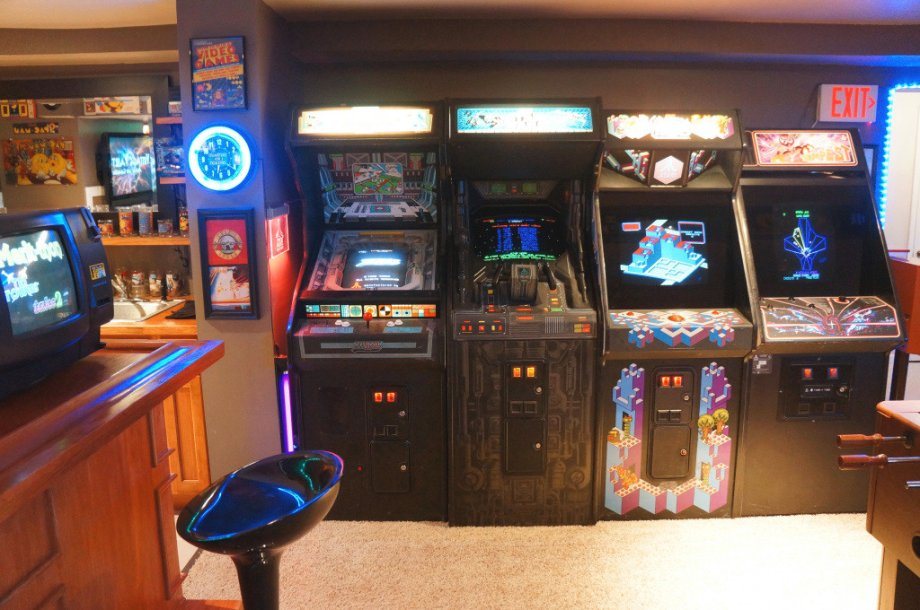
A trip to Google Image Search will nab you some great pictures of people's home arcades.  I said earlier that I have seen some "bad" arcades in homes that look like garbage and cost a ton of money.  I am not going to show you examples because these people still worked hard, and I do not know the whole story.  What if the arcade room they have built is exactly like the arcade they had, so all the warts and flaws are there on purpose?  It could happen, people spend $5000 on Fender guitars that are made to look 50 years old after all.

That picture above is what is right about home arcades.  It is way more money than I'd ever spend, but the guy knows what the hell he's doing.  It is not just about having some machines in a room, it is about getting the feel.  Look, because of technology I can play anything made before 2002 for very little money.  If I want to sit in front of a computer screen and use a connected PS3 controller, I can do that.  It is not about playing the games, its about creating an experience.

This one is more like I see my actual one being one day.  Just one feature of a basement entertainment room, near the food area.  I know this is actually just a small part of a larger arcade with stuff I do not want.  I never wanted a pool table, I never wanted a hoops game or a foosball table.  I am a video gamer.  I never wanted to play the pinball games when I was young, and I only grew an appreciation for skeeball in my late 20's.  All that's lucky for me because that shiz takes up a lot of space and a lot of money.

So what do I want?

This man's home arcade is probably the most expensive to fit in a one bedroom area.  Even so, he is sort of my inspiration for this.  I do not live in New York, and I do not want his rare and unobtainable arcades.  He has one of 10 Disney produced Wreck-it-Ralph arcades, and he has the literal machine used in the King of Kong documentary.  I have no use for that stuff.  I think I can do a room like that for way less money.  He was my inspiration for pricing out a "normal" sized room arcade.  He is also my inspiration in another way; his collection of quarter vending machines.

This is perfect, this is the kind of thing from people that "get" it think of that no one else does.  In his interviews he talks about how he bought them just for an atmospheric piece of decor, but how it has become his most favorite addition to the arcade.  He says that no matter who comes in, be it 60 year old journalists to the 20'something bloggers, before they get to the video games they see these vending machines and start telling stories.  He claims he never asks, people just light up and give him a story about using these machines as a kid.  Reading this instantly brought back memories of football helmets at Ingles.  It brought back sour gumballs, dinky plastic banannas, handfuls of Runts, and even brazil nuts.

My vending machine story.  There used to be a really cheap super market where there is a school now.  They used to rent that parking lot out for fairs every now and again, and I still have dreams of those fairs.  Anyway, fairs aside, they had vending machines in the front like everyone else, but they had one that no one ever had.  It was a vending machine full of oily, greasy, salty Brazil nuts.  Growing up the only way to get a Brazil nut was to wait to get some at Christmas, and you had to break the shells yourself, you know how hard that is as a kid to break those?  You use a hammer, and you end up getting a handful of crumbs.  Anyways, for a quarter you got a handful of perfect Brazil nuts, so in a way it was like getting a little Christmas every time I went to the store with my aunt.

Do you see?  I bet you thought of stories with those machines too.  So even though this guy inspired me to do "better" than him for way less money, and I've probably even talked a little trash about him... He had a great idea that made me change my mind about him, and now I want that for my own arcade one day.

Arcade Project 01: Plans and Why

"They came for the record store, and I stood by silent.  Then they came for the video rental chain, and still I said nothing.  When they came for the arcade, and there was no one left to defend me" -Arcade owner


I am fully aware that there is this weird nostalgia thing where we think that people of the future need to experience things we experienced in order for them to be "correct" after us.  The above paraphrased joke quote is a good example of the stuff I hear all the time.  All through the 2000's as the Tower Records and the small time record stores were dying as digital took over, we heard from their fans that the world is losing something special.  I really did not care about that because the march of technology is a good thing, as I say, and besides, there were never any good local record shops near me.  It was always chain stores shoveling the latest pop music out.  Lately, because Blockbuster going out of business, I hear a lot of nostalgia for rental stores.  I have great memories of rental stores, and it was fun looking through the cover art for movies and games and trying to judge like that for a gamble.  It really did allow me to experience more games for less money, but I had stopped using them long ago.  I never developed a relationship with any store workers, I mainly used chains and super markets because the mom and pop stores specialized in... garbage.


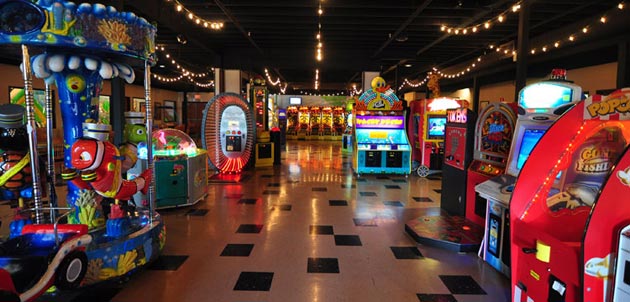
To tell you the truth, I do not even have a lot of arcade memories, and I think that's why I want one.  My arcade memories are regulated to the skate rink, the local movie house, and Six Flags.  I never frequented one very often, and by the time I was old enough to have a job and go to the mall every pay day, the arcades were filled with crap sports games and the latest gun simulator.  Gone were my great fighting games, gone were the Neo Geo shooters, and the "classic" section was filled only with the crap that the arcade could not get a good price on with Ebay.  It was much more financially viable to flip a Pacman arcade for $900 to some sucker than wait for that $1 of change at the end of the week.  Let me tell you, I looked for great pictures of packed arcades, and it is very hard to find any quality ones.  Almost all, without fail, is actually someone's home arcade.  That goes to show you why they died out.


The only time I really felt the "I want later generations to experience this" kind of thing was a couple of months ago when I really thought about a world without Nintendo.  That's a console thing, and there are plenty of ways to have old console experiences for very little money.  That really has nothing to do with an arcade either.  So I'm still asking myself, why do I want an arcade?  And I have to tell myself that I think I want to create the memories I may feel I have missed out on.  I think I am the section of the population that wants what they were not able to have earlier instead of the "recreate past experiences now" kind of people.  I want to be able to visit a "get away" place in my home when I need to wind down after work.  

In my mind, in the future, I have a fully finished basement.  I do not see the entire thing being an arcade, I see a corner of the area, near the food area, but away from the movie area, as having a couple of arcade and video game knick knacks.  I have seen people spend INSANE amounts of money on a home arcade and come away with something that looks awful.  I've seen people that never really liked video games get whatever they can grab and put it in a corner... and still spend insane amounts.  I think I can do better, but I am not really sure.  So I want to do this set of blogs as a sort of "test" of how much something would actually cost.  I want to get my head around the cost of doing one.

This is a list of what I want to do:

Carpet, Walls, Removable Decor
Food area with vending
3 or 4 machines depending on what I find

Small list right?  Well its deceptive.  I am trying to do this on a cost conscious budget, this is not a "dream" set up, I want a "realistic" set up, but there are things I want that will increase the price, but also some ideas I have had that will decrease it, and ideas that I think are clever and will actually reduce the price in the long run.


Tuesday, July 8, 2014

1994 In Gaming: A contender for Best Ever

1994: Great Starts

This year is the 20th Anniversary of 1994, one of the greatest years in gaming.  When it comes to film buffs, there is a popular discussion "game" they like to play where they argue for the greatest year in movies ever.  One of the first things you have to do is consider the metrics of measurement to use.  Do you factor in money, attendance, influence, what exactly is success?  Well this has also been done for video games.  The general consensus in movies is that 1939 is the greatest year in Hollywood, with a couple of really close 2nd and 3rds.  When it comes to video games, it is also a foregone conclusion that 1998 is the best ever, but it has a run for its money with 1994.

Let's start 1994 with some "beginnings" in the industry.  Neversoft, of Tony Hawk fame, is founded, as is the FPS juggernaut 3D Realms.  Current huge studios get their start as Bungee released Marathon, and Epic releases Jazz the Jackrabbit.  Shiny Entertainment also releases Earthworm Jim, it set a new standard in 2-D animation that made everything before it look flat.  Fans of the X-men cartoon got X-men: Children of the Atom.  Shadowrun on the Genesis was a taste of what was to come with Bio-ware style RPG's AND open world RPG's a decade later.   Bethesda released the first Elder Scrolls video game, Arena.

In Tech we get some footnote fizzles as Neo Geo CD and PC-FX are released.  We also have end of the year Playstation launch in Japan.  1994 was the year of Sega though, as they release the 32x, the Nomad, and the Saturn all in 1994, sadly sewing the seeds of them leaving the hardware business.  Sega did, however, start the first major non-physical software distribution home service when they started the Sega Channel, a cable box adapter that streamed Genesis games into your home.  Some monster 3-D polygon franchises began as Daytona USA and Tekken were released to arcades.  Road and Track Magazine sponsored a game that I would later have some of my first 32-bit next gen memories from, as I rented the game with a Playstation a few times through the Summer of 1995; the first Need for Speed.

The Big 3 Number 1
Blizzard released its genre defining game Warcraft in 1994 as well.  Nowadays we know of Warcraft as this huge cashing printing, world wide economy stimulating MMORPG, but in the 90's it was just as revitalizing for the Real Time Strategy genre, and popularized it enough to make it one of the largest genres in the world.  Warcraft feeds directly into not only MMORPG's but also into the MOBA's, arguably the highest grossing money makers in the industry.  While it wasn't the first, it was one of the most polished, and the Artificial intelligence of units allowing the player to be viewing and managing other parts of the game while still getting their work done was mind blowing when I first saw it.  Simcity with orcs and war?  YES!

 Just like many years in movies, 1994 was a huge year for sequels, fortunately unlike Hollywood, sequels can be great gaming. A few quick shoutouts include Super Street Fighter 2 Turbo, and its introduction of Akuma, my favorite gaming badass.  Sonic and Knuckles was released with an innovative stacked cartridge that let you put older sonic games in the top to allow you to play Knuckles in older Sonic games.  The cult classic(and Ebay darling) Earthbound(Mother 2 in Japan) was released here.  Doom 2 raised the bar in the FPS genre as Id had so far reigned un-challenged as the kings of First Person Shooters.  Rare released Donkey Kong Country, a pseudo-sequel to Donkey Kong that amazed people with its pre-rendered "Silicon" graphics.  While Mortal Kombat 2 was released in 1993, its biggest event was when the SNES version was released un-censored, heralding a "new" attitude at Nintendo for the first time.


The Big 3 Number 2
In 1994 we also got a few games that are contenders for not only best of their franchise, best of their genre, but even contenders for best games of all time.  Final Fantasy VI is a game I write about a lot.  In fact, you're going to be sick of it if you read my stuff as I put it out.  I'll do a quick summary here.  Final Fantasy VI raised the bar in story telling for all genres.  The soundtrack was done in the style of a movie soundtrack instead of the traditional gaming one.  Themes weaved in and out of the songs, reoccurring at key moments and signaling changes in character development.  Cinematic story telling evolved as perspectives were changed for certain events, finally doing away with the fixed overhead perspective.  Final Fantasy VI convinced Japan they could market RPG's in North America, leading to more releases, and leading Squaresoft to invest millions into the next sequel.

The Big 3 Number 3
In Japan the Metroid series is not very popular.  That is why it took so long for a sequel to Metroid to reach consoles.  The 3rd title in the series Super Metroid is widely considered one of the greatest achievements in game development to ever exist.  The attention to detail, from dripping water to tiny insects, was something thought not possible on the SNES.  The game even amazed people with some spoken dialog at the beginning.  It pushed the 2-D platform genre to heights that would not be reached again for several years.  While Donkey Kong Country got applauded for its tech, critics knew it was Metroid that had the gameplay.  There are many games in the world that have lone protagonists, but very few make you feel alone.  Super Metroid gave you the sense of loneliness like few games can.  Then, in the end, it manages to teach you that kindness too can be rewarded in our worst, most hopeless moments.

How does 1998 beat 1994 in so many lists?  In many ways 1994 was a build up, a stepping stone of things to come.  New technology was still too young for the truly amazing things to happen just yet, but games like FFVI and Super Metroid had to set the stage and prove certain things work before they could be perfected.  The innovations of 1998 are still being built upon today, and so 1998 feels like the first "modern" year of gaming with its cinematic Metal Gear Solid and its hyper detailed 2-D art in Symphony of the Night.  Also in 1998, people brought their money.  Video Games were on the verge of being bigger than the movie industry, but not nearly as widely sold as today.  1998 was over the top financially successful compared to the critically acclaimed, yet still niche market, that was video games in 1994.

1994 was a strong year, one of the best, and I hope those that read this have memories of games made that year and that maybe I brought back a little bit of your childhood while reading it.  With the indie revolution, I feel like it gives some of these games another chance that even 10 years ago they were rejected.  Super Metroid, Final Fantasy VI, Warcraft, all 3 are just as good as a lot of the mobile indie games you see now, both in graphics and especially in gameplay.  In the PS2 era, these games were seen as outdated, old, and no good, but the appreciation for such "primitive" games has come back as of late and it makes me happy to see the trend going into that direction.


Thursday, May 15, 2014

The Sound of an Era: Sound Chips


The term "8 bit" is different from the later generations of gaming.  No other generation has such a singular meaning when it comes to "8 bit".  If you were to say "16 bit", well you have several ideas that come to mind, and even though there's really 2 options for 16 bit, it muddies the area of nostalgia to the point that you have to make a distinction.  Even later, 32 bit, you have lots of options and then you also have the N64 thrown in there(hint: it wasn't 64 bit).  Today I want to talk about an aspect of "8 bit" that you may not realize contributes to its unified "feel" among its games:  Its sound.

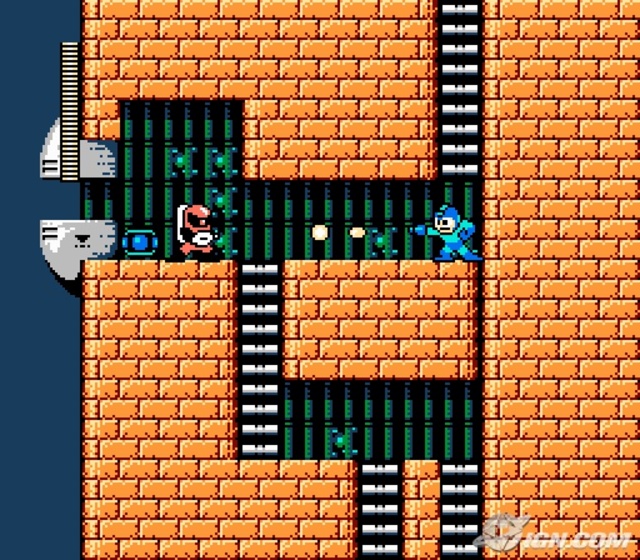
Think about the big games of the day; Contra, Mario, Castlevania, Ninja Gaiden, Mega Man.  Somewhere in those memories are probably the music you heard.  Now, think about the music in your top games... and realize that they all pretty much have the same sounds and effects, just arranged differently.  That's a kinship in gaming that does not run through into the later generations.  The Nintendo had a sound chip in it that everyone used as a common source, and it tied all the games of the era together.

The sound chip inside it had its set of blips and beeps, and the games issued commands of what order they were played in.  Let me put it another way.  With digital, you can record a wide variety of instruments, orchestras, and bands.  You are only limited by reality and sample quality.  The Nintendo Entertainment System shipped with a pre-packed band that you could not change.  All games had the same guitar, bass, and drums that all the others had.  Starting with the SNES, music went digital.  Music was pre-recorded, digitized and played back at a later date, much like how MP3's work.  Your Nintendo Entertainment System was an actual music instrument playing live for you.

DJ culture in Japan and Korea is huge, and their forefathers are the game composers from this era of gaming with sound chips.  In that area you will not only find "8 bit" synth masters, but also "16 bit" because the Sega Genesis also used a sound chip instead of a digital system.  The "west" culture is awakening to the sound, but its old hat over there, where the actual composers of games of the era are producing music in the clubs.  Today in the west, we are modifying old NES's and Gameboys to be used live in synths.  This too has been going on for a long while in Korea and Japan, where these systems(with the Sega Genesis) were actually pretty powerful for this purpose, and very cost effective compared to dedicated synthesizers in the 80's and early 90's.

Our gaming generation eras are not as distinct any longer.  It is hard to pin down what generation a game is from because there is such a wide berth of capabilities between game systems, and then with the bit-perfect recreation of any music imagined into digital format, you can't pick an era by its music either.  With the inclusion of millions and millions of colors, and the virutally limitless resources game makers can choose from to make games, our new eras of games just don't have that "we're all a part of a club" era like the 8-bit days.

Wednesday, May 7, 2014

Iterations or Street Fighter Syndrome

The world of video game journalism thrives on the ability for the "journalists" to be snarky and inject humor into their journalism, that's just the state of things.  One of the ongoing and longest running jokes is about Street Fighter and its numerous editions over the years.  Its an easy joke, and somehow gives the journalist "cred" to say it, with bonus points if they actually think they are the first to make the joke.  

I feel like I have to explain why it makes sense to have updates and iterations to Street Fighter, and indeed other fighting games.  Also maybe even delve into why this is not "Madden-nomics".

A Crowd of Competitors

From the the word "Fight!" Street Fighter was about drawing a crowd of people together to play against one another.  Sure there are CPU controlled opponents and a half baked story in there, but the game is made to be played competitively against humans.  Now, if you have Street Fighter II, Street Fighter III, and Street Fighter IV all done within the span of 3 years, and all of them play different, then you have split your talent pool.  There simply will not be enough people in either to keep it going, and having to keep up with 3 different games just to ensure you have someone to play against is a little nuts.  Let's not forget that if your old version is still popular, you're going to compete against yourself and cannibalize your fans.  Smaller updates means people have no real reason to stay with the past version.  It is close enough that it is painless to move on.  So reason: Iterations don't Split your Fanbase.

Time to Train

Looking at the select screen in Street Fighter IV's later iterations can be daunting, look at the pure number of fighters.  Old players like me had the benefit of learning new characters as they were created.  Instead of learning 50 characters, we got to learn the first 8 in 1991.  Then every couple of years 4 new characters came.  While technique, timing and game change, the way to play each of these characters have stayed consistent.  Still, this is unfair for new players to be expected to know how they all work.  The #1 way to be better at fighting games is to know your opponent, know what to expect from the character.  Because Street Fighter IV came out in 2008, we have had 6+ years to get better at it.  If you spent a few months getting better at it in 2008, it'll only take a little time in 2014 to get your bearings.  So reason: Iterations give you time to learn.

Madden'nomics

Madden will have you pay $60 a year to get updated rosters and some superfluous game modes.  Looking at Street Fighter IV, you might have payed $60 for the original, but to update the previous to the current will cost you $15 bucks each step up... for a month or so, then drop to $10.  Looking at Call of Duty, another annual series, you actually do not have iterations in the same way.  Call of Duty actually has 2, and now 3 developers creating their games and staggering their release.  It is actually 3 years before the next iteration of that "style" of Call of Duty comes out, and so by then there's enough forgetfulness and new features added that it doesn't feel like an iteration.  So another reason:  smaller alterations means smaller budget, means cheaper updates.

Hell is other People

So what about the genre as a whole, why doesn't everyone else do this?  Let me tell you a little secret:  Unless its a once in a life time game like Killer Instinct, they DO.  Look at what is considered high in competitive circles.  Blaze Blue, Guilty Gear; looks like there are a million of those games, there's really only about 2 of each, the rest were iterations.  King of Fighters?  There's about 3 of those, but for a while every year there was an update.  That doesn't matter, they really only redid the game and made new artwork about 3 times.  What of Mortal Kombat?  Ok, here's our dirty little secret: some games are slightly large iterations even if they are numbered different.  Mortal Kombat 1-3, Tekken 1-3, 5-6, Soul Calibur, these games keep the same core game with updated visuals.  I know they add bells and whistles, and I'm not saying anything bad about them; I love ALL those games I mentioned, but its true still.  Are you good at Tekken 2?  Bet you'll kick ass at Tekken 5.  (3 images of Mortal Kombat, 3 different games... believe it or not)

Its just a simple truth that creating a brand new fighting experience every year, or even every other year, just is not good business for fighting game developers.  It would also suck pretty badly for the players as well.  So yea, its an easy jab to make, being snarky and "clever" making the "I'll wait for Street Fighter Omega Awesome Dash update 12", but you're really just showing idiocy, a small mind, and the lack of knowledge in your field to create original and even topical humor.


Friday, April 25, 2014

Final Fantasy: Ivalice

Ivalice was first mentioned as the setting of Final Fantasy: Tactics.

To talk of this, though, we have to go further back.  Back to a series of video games called Ogre Battle.  Ogre Battle was a sort of real time strategy, turned based RPG hybrid that took place in a magical realm.  The story dipped into ambition and strategy between armies, but was not very detailed.  With Ogre Battle's success, the director became a household name in Japan.  With this new hit on their hands, they asked the director to make another game.  The director was Yasumi Matsuno, and events of the world would change the game, and his legacy.

In the early 1990's, the Yugoslav Wars were highly televised and covered around the world.  Matsuno would see what the war, and the ethnic cleansing in Bosnia, would do to a modern society.  He became determined that his next game would explore the horrors of war, and force people to think of how horrible it was.  He then created Tactics Ogre, a game very strongly respected, even today.  Through the use of telling a smaller personal story, like that on a stage, Matsuno was able to get the epic story of war to the audience in a digestible way.  Studio pressure and being unhappy with his company, Matsuno left Quest, but was soon hired by Squaresoft to produce the first "modern" spinoff of Final Fantasy; Final Fantasy Tactics.  Ivalice was the world he created for the game.  In it, he mixed his political story with the fantastic elements of Final Fantasy.  Summons became religion, Chocobos became warhorses, and the Final Fantasy job system got one of its best incarnations.


When discussing Final Fantasy, there is a line in the sand with some people.  That line is "no spinoffs", that way you do not have to discuss the re-titled gameboy games(which aren't Final Fantasy, but are Secret of Mana and SaGa games), and Mystic Quest.  This also meant that many put Final Fantasy Tactics into that.  This stopped because Final Fantasy 12 was developed in the world of Ivalice, making the world "Canon".  This does interesting things because now the Metal Gear Solid/Metroidvania game known as Vagrant Story is technically part of a canon Final Fantasy world.

Many people debate if the world is in fact the same world or a different version each time with just a sprinkle of allusions to the other titles.  Others point to a timeline that can make sense of how some things exist in one world but not in the other.  I personally subscribe to the timeline that goes like this:  Final Fantasy 12, Final Fantasy Tactics, Vagrant Story.  In Final Fantasy Tactics you find ruins while exploring that have broken airships, and they talk about moogles being extinct but once existing.  This firmly puts it ahead of Final Fantasy 12.  In Vagrant Story the religion of Final Fantasy 12 is talked about as an old "pagan" religion, and that the new religion took place after an old one was found to be heretical.  This religion, I believe, is the one from Final Fantasy Tactics.  Also, the grandson of the historian that wrote Final Fantasy Tactic's account of historical events is the one that wrote the "truth" of Vagrant Story.  By Vagrant Story, magic is a rare thing, only practiced by those that know the secrets, in Final Fantasy 12 and Tactics it is common place.  To me this timeline makes the most sense.  I also have suspicion that Lea Monde from Vagrant Story is a settlement built on top of the Ancient City of Giruvegan in Final Fantasy 12.  Both cities seem to be entire cities that are actually magical sigils, arranged in circles, and tied to a power source in the center.  Matsuno has said he never intended to make Vagrant Story part of Ivalice, but this was obviously an intention that was thrown away before the game actually began, so to me it is absolutely the same world.

Not all games set in Ivalice have been made by Matsuno, since Squaresoft owns the rights.  A strange happening is Final Fantasy Tactics Advance, which technically happens in the real world instead of Ivalice.  Its world is a "made up" world that takes place in a magical book, so is not actually this Ivalice.   Tactics Advance A2 does though, as does Revenant Wings and Crystal Defenders.  So while Matsuno has had a strong hand in controlling how this world developed, he hasn't had complete control.

The world of Ivalice has had many critically acclaimed games to take place in it.  When Famtisu "Perfect 40's" were more rare than snow in hell, there were 2 games that earned it in this world, "Final Fantasy 12" and "Vagrant Story" were among the first 8 to get the score and Matsuno the only person to direct two "Perfect 40's".  Sadly the games were never financial hits compared to the JRPG's of the late 90's.  With the entire Ivalice Alliance set up taking place in a waning era of Squaresoft, we are likely to not see much else happen there.  This may have been a contributing factor to Matsuno deciding to leave Squaresoft after Final Fantasy 12 was taken out of his hands and tinkered with heavily before release.

Friday, March 28, 2014

Skypp's Final Fantasy Rankings Part 2: Fanfare

Part 2: Fanfare
(Part 1: Here)

Re-pasted disclaimer from Part 1: 

This is a listing of my ranking of Final Fantasy Core games as of 2014.  I'm not going to go too in depth into the why's and how's of each game, as each game could and probably will eventually have its own post.  I am keeping to the Core numbered Final Fantasy games, excluding the MMO's(11 and 14), and excluding 3 as I have not finished it.

I am including some information along with the rank.  There will be 2 numbers after the game's title: the first is my game grade(1-10) in context of when it came out.  The second is what I'd grade the game today.  I would also like to point out that when I talk about "Graphics" I am also talking about the original versions, as the remake graphics of FF1 and FF2 are really really nice, and the 3D versions of 3 and 4 are pretty good.  Also I will try to keep non-vague spoilers to a minimum.

5 Final Fantasy 13 (8) (9)


Here we have an oddity.  While doing my list, this is the only game that I would rate better today than I did the day it came out.  Not only have I vastly enjoyed this game, it has only grown in my eyes as time has gone by.  Many of the people that heap crap on this game seem to praise 10.  A lot of the crap said about 13 is true of all JRPG's, and I believe its ripping and bandwagon hatred is more a symptom of the rejection of JRPG's in the last 5 years or so(an era I believe we are finally growing out of due to Bravely Default, Ni No Kuni and South Park).  Anyway, I loved this game.  I loved the characters, I loved that the characters grew over the course of the game(something that never happened to Tidus or Squall), I loved that everyone was there for a reason(sadly something that can't be said about a game higher on my list).  I saw visual things that stunned me.  I heard music that made me tear up.  I took part in a story that grew epic, world changing, and emotionally draining by the end.  Despite looking "modern", despite having not that great combat(hence the 8 rating), it felt like a Final Fantasy should.  Why did it go from 8 to 9?  The characters are still growing on me.  The Sazh and Vanille scenes in Nautilus are worth the play through alone(unless your're a sociopath determined to prove to everyone you don't give a fuck about anything).

4. Final Fantasy 7 (10) (8)

This was the first Final Fantasy that I played near its launch.  I remember playing the demo, I remember picking up the game, and I remember playing every bit of the 3 play throughs I played it in a row when I got it(I got a lot less games back then).  I can't really say anything about 7 that hasn't been said.  It was THAT revolutionary when it came out, even if you did not like it.  It ushered in a rush of JRPG's that have not happened since.  A whole generation of Japan's best got sent our way because of the success of 7.  Why do I rate it 8 now?  Well, the character models aren't even cute any longer.  The cutscenes, while amazing for their time, are very short.  Many of them are rendered at much less quality than the others.  The music, story, and presentation get high marks, and the Materia system mechanic ranks as my favorite of all games, not just Final Fantasy series.

3. Final Fantasy 12 (8) (8)

The Matsuno Final Fantasy.  The one that took place in an already established world.  The one that has a semi-Final Fantasy and a non-Final Fantasy as part of its universe.  This strange Single-player MMO-esque Final Fantasy is polarizing.  The combat is confusing to many(though it is very much like what Dragon Age did later), and the main characters don't seem like main characters at all.  But that story.  I really wish there was more story in between certain dungeons in the game, and I kind of wish the story became more apparent much sooner, but holy crap; when the story gets going, its hard to not be fascinated.  This is my pick for best overall story in a Final Fantasy.  When I rate story above all, you can see that I find faults with the game's pacing and presentation enough to keep it out of the #1 spot.  Basch is ranked 3 in my favorite characters of all time list.  My favorite duo of all time is Balthier and Fran.  My favorite villain of the series is Vayne by a wide margin.

2. Final Fantasy 9 (8) (8)

Final Fantasy 9 is the game that most exemplifies what a Final Fantasy should be.  It was Sakaguchi's send off to the series, and he pulled out all the stops for it.  The story goes from a small matter of royalty to a universe changing, epic story of survival.  The entire game is an exploration of identity.  Identity as a person, as a legacy, as a civilization, as a memory, and what defines all that.  My favorite character in all of gaming is Vivi.  My favorite sub-story in all of gaming is Vivi and the Black Mages.  The cutscenes are the best in the series, with practically all of them comprising of "oh shit!" moments.  The world is beautiful, my favorite setting of all Final Fantasy games.  The reason this game is not in the #1 slot is not nostalgia, as many will accuse, but because that aside from Vivi and a smidgen of Freya, the cast is rather weak on meaningful characterization.  Only Irvine is a bigger disappointment to me than Amarant.  Amarant's cool look wrote a "badass" check that did not get cashed in.

1. Final Fantasy 6 (10) (9)

The only Final Fantasy to score a 10 from me that was not a first of its tech generation.

Graphics?  It did things you would not think would be done on the SNES.  It looked so good that many PS1/Saturn RPG's looked worse.  From the gears in the town of Narshe, to the beautiful sunset on Cid's island, the world was full of interesting details.  Music? Best in the series.  Every character got a theme, and I could hum them all by the end of it.  Hearing a certain music floods my mind with memories of where I heard it.  Only 7 comes close with a couple of tunes that match 6's memorable score.  Final Fantasy 6's score is close to perfect.  The story is grand, and while it may not get 12 or 9 "epic" it is suitably world shattering.  On top of that, all the side stories fill all the pats of humanity that the main story doesn't touch.  You get Cyan's duty and family, Edgar's unresolved relationship with his brother, Setzer's hidden sadness, and Shadow's silent enduring of pain.  There are over 10 characters in Final Fantasy 6 and all except 1, maybe 2, get the spotlight.  Combat is fun and complex, the Esper mechanic is really awesome, and the fact that every character gets their own special attacks makes every character different and fun.  Sabin even uses Street Fighter style movements to do his abilities.

Final Fantasy 6 is a masterpiece of gaming, and taken as a whole, it still stands the test of time.  It only loses a point for its apparent bad(yet memorable) translation, and the aging of the graphics(despite still being very beautiful in my opinion).